
What is Digital Marketing 2026 | Dynovate Digital
Digital Marketing Strategy for Small Businesses in South Africa
A plain-English digital marketing strategy for South African small businesses. Set goals, choose your channels, plan your budget and follow a simple 90-day plan.
A practical digital marketing strategy for small businesses
One clear plan, from first goal to 90-day review.
Who this guide is for
This guide is for small business owners in South Africa who want a clear digital marketing strategy instead of a pile of random tips. In addition, it helps managers who need to brief a team or judge a plan someone else has handed them.
What you will find here
First, you will find a plain-English definition of a digital marketing strategy and the South African factors that shape it. After that, you get a seven-step framework, a channel guide, a 90-day plan and the mistakes that stall most small businesses.
How to use it
If you are starting from scratch, read it in order. However, if you already market online, jump to the step that matches your biggest gap. Then return to the 90-day plan to put the pieces in order.
What a digital marketing strategy really is
Definitions first, so the rest makes sense.
What a digital marketing strategy is
A digital marketing strategy is a plan for how your business will win customers online. It decides who you want to reach, which channels you will use, what you will say and how you will measure results. In short, it connects your marketing to real business goals, such as enquiries, bookings and sales.
Strategy versus tactics
A tactic is a single action, such as posting on Instagram or running a Google ad. A strategy, on the other hand, is the reason you take that action, the order you take it in and the result you expect. As a result, a strategy stops you from doing busy work that does not move the business forward.
Strategy versus a marketing plan
Also, people often use the two terms as if they mean the same thing. However, they are different. First, the strategy is the thinking: your goals, customers and channels. Second, the plan is the schedule: what happens each week, who does it and what it costs. Therefore, you need the strategy first.
Why small businesses need one
Small businesses have limited time and budget, so every rand needs a reason. For this reason, a clear digital marketing strategy shows you what to do first, what to ignore and what to leave for later. Moreover, it gives you a way to check whether your marketing is working.
Why your business needs a plan
Four reasons a strategy beats guesswork.
Customers search before they buy
First, most customers look online before they call, message or visit. For example, they search Google, check reviews and scroll your social profiles. If your business is hard to find or looks inactive, they move on to a competitor.
Budgets are tight
Because budgets are tight, you cannot afford to try every channel. Instead, a strategy helps you put your budget where it is most likely to bring customers. Consequently, you avoid paying for tools, ads or posts that do not match your goals.
Results can be measured
By contrast, digital marketing shows you what happens, unlike a billboard. For example, you can see visits, calls, form enquiries and WhatsApp messages. As a result, you can stop what fails and do more of what works.
Small steady wins add up
Also, digital marketing compounds over time. For instance, a good page, a handful of reviews and a consistent posting habit all strengthen each other. Therefore, starting with a plan today pays off for months afterwards.
What shapes digital marketing in South Africa
Five local factors your strategy should reflect.
Mobile first, data aware
First, most South Africans browse on their phones, often on mobile data. Therefore, your website must load fast and work well with a thumb. In addition, Google judges the mobile version of your site first, so mobile quality affects your search results.
WhatsApp is how people talk to businesses
Second, many customers would rather send a WhatsApp message than fill in a form. For example, a WhatsApp button on your site and Google profile can turn a casual visit into a conversation. Consequently, your strategy should make it easy to message you.
Price awareness and trust
Also, South African customers compare prices and look for proof before they commit. Similarly, reviews, clear pricing and visible contact details build trust quickly. Therefore, show real evidence of your work rather than only claims.
Local intent is strong
In addition, many searches include a place, such as a suburb or the words near me. Because of this, a local business should state clearly where it works. Moreover, a complete Google Business Profile helps you appear when nearby customers search.
Load shedding and reliability
Finally, power cuts affect when people browse and how reliably websites run. As a result, choose stable hosting and keep your pages light. Also, plan posts and ads for the times your audience is actually online.
Want a plan built around your business?
Book a free consultation and we will review your online presence with you, with no obligation.
The 7 steps to your strategy
Follow them in order. Each one builds on the last.
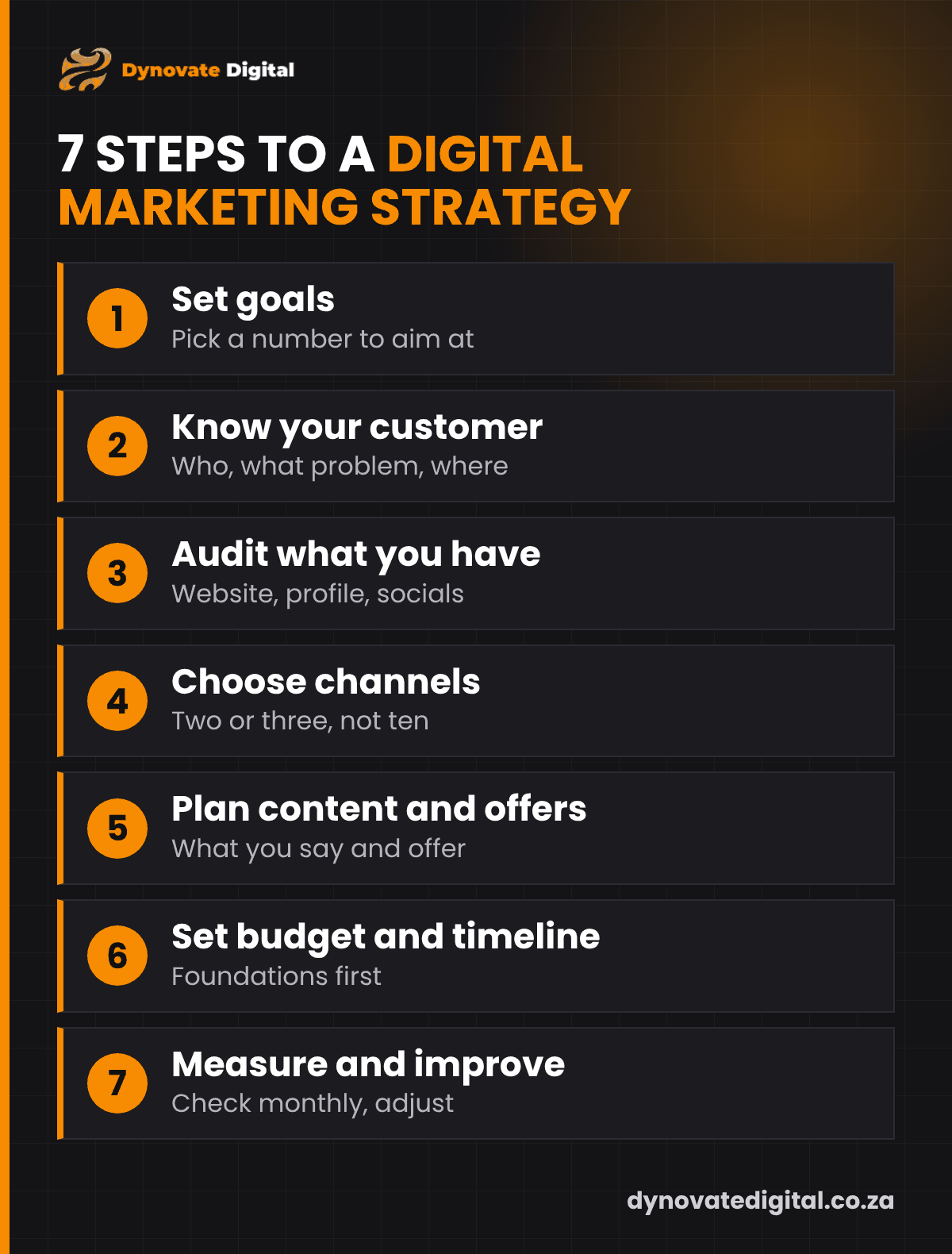
Step 1: Set goals you can measure
First, start with the result you want, not the channel. For example, “ten new enquiries a month” is a goal, while “be on Instagram” is not. Then work backwards: how many visitors, calls or messages do you need to reach that number? As a result, every later choice has a clear test.
Step 2: Know your customer
First, write down who buys from you, what problem they have and where they look for help. Next, note the words they use, because those become your keywords and your headlines. Moreover, talk to your best customers. In fact, their answers are worth more than guesses.
Step 3: Audit what you already have
First, check your website, your Google Business Profile and your social profiles. Is your information correct and consistent? Does your site load fast on a phone? Also, look at your competitors. Therefore, you will see quickly where you are ahead and where you are behind.
Step 4: Choose a few channels
However, you do not need every channel. Instead, choose two or three that suit your goals, your customers and your budget. For example, a local plumber needs search and Google Maps more than TikTok. Meanwhile, a fashion shop may need Instagram first. Also, the channel guide below helps you decide.
Step 5: Plan your content and offers
First, decide what you will say and what you will offer. In practice, this means service pages that answer questions, posts that show your work and a clear call to action on every page. Additionally, give people an easy first step, such as a free quote or consultation.
Step 6: Set a budget and a timeline
Once you know your channels, decide how much you can spend each month, then split it by priority. First, fix your foundations, such as your website and Google profile. After that, add the channels that bring customers. Also, agree a realistic timeline, because most channels need a few months before the picture is clear.
Step 7: Measure, learn and improve
Finally, check your numbers every month. Which channel brought enquiries? Where did people leave your pages? Did your posts get replies? Then change one or two things and measure again. In short, your strategy is a living plan, not a document that sits in a drawer.
Which channel fits which goal
Choose two or three, not all of them.
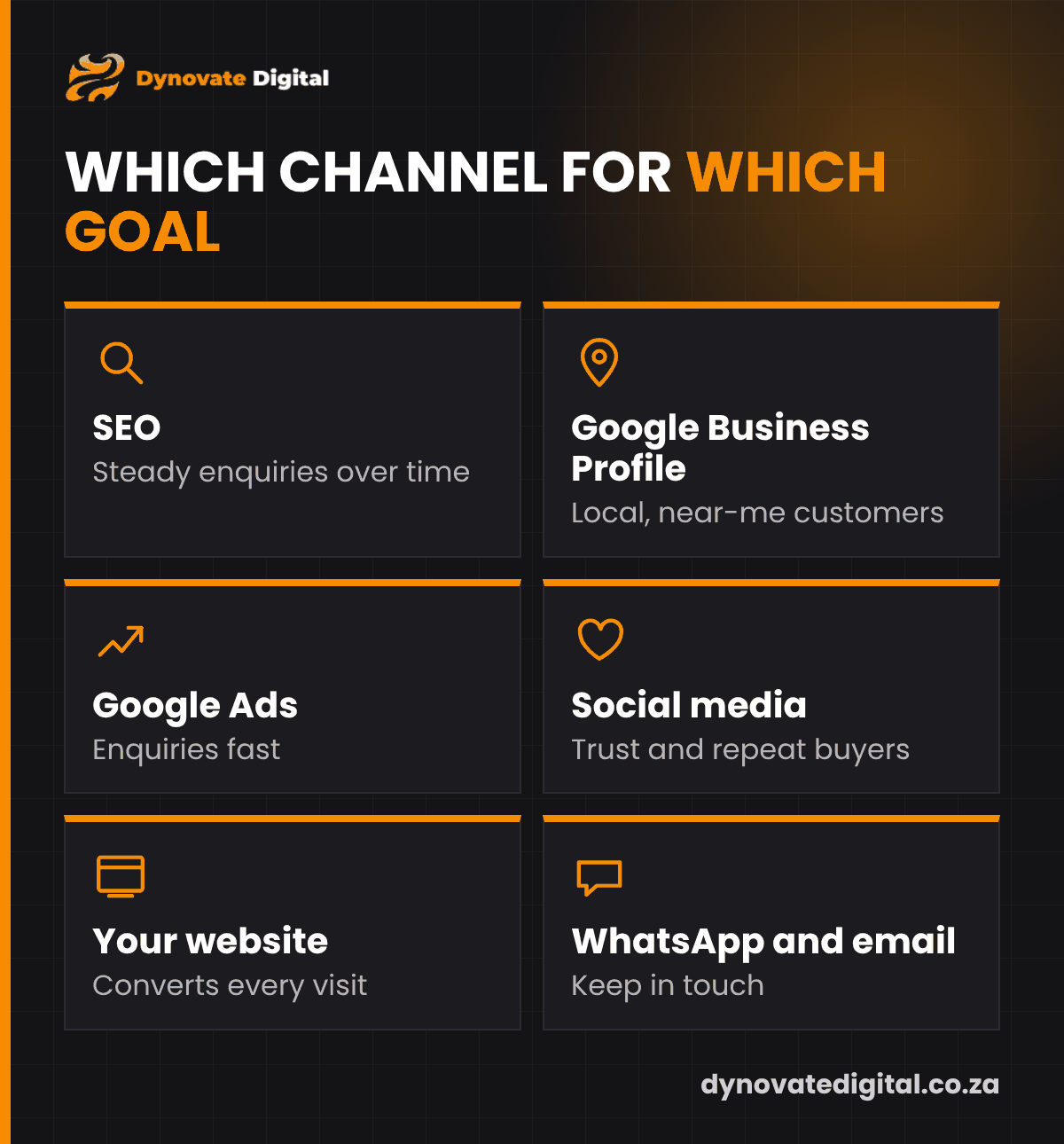
SEO
Best for steady enquiries over time. In short, SEO helps people find you when they search on Google, and it keeps working once it builds. See our SEO services in Midrand for how we do it.
Google Business Profile
Best for local businesses. In addition, a complete profile helps you appear on Google Maps and in near me searches. It is one of the cheapest and fastest wins for service businesses.
Google Ads
Best when you need enquiries quickly. As a result, paid search puts you in front of people who are ready to buy today. However, you pay for every click, so your website must convert well.
Social media
Best for trust and repeat customers. In addition, regular posts keep your brand visible and show your work. See our social media marketing in Midrand service.
Your website
The base for everything else. Because every channel sends people to your site, it must be fast, clear and easy to use on a phone. See our web design in Midrand service.
WhatsApp and email
Best for staying in touch. For example, a WhatsApp button and a simple email list help you turn one-off buyers into regulars, at very low cost.
Start in the right place for your business
The first move depends on what you sell.
Local service business
First, set up your Google Business Profile, then add a service page for each service, then reviews. Later, add Google Ads if you need enquiries faster.
Online shop
First, build a fast, clear website and good product pages. Then add search ads and social media to bring in traffic.
Professional firm or B2B
First, build trust with a clear website, helpful guides and LinkedIn. Then add SEO for the services your clients search for.
Start-up with no website
First, build the basics: a simple, professional website, a Google Business Profile and one social channel. Then add SEO once your pages are live.
How to measure your results
Know what is working and what to change.
Measure results, not just activity
Although likes and followers feel good, they do not pay the bills. Therefore, track business results first: enquiries, calls, WhatsApp messages, bookings and sales. After that, look at the numbers that explain them.
The numbers worth watching
Next, watch your website visits and where they come from, your enquiries and conversion rate, your cost per enquiry, your Google impressions and clicks, and your reviews. Moreover, note which pages bring the most enquiries, so you can improve them first.
Review monthly
In fact, a monthly check is enough. For example, compare this month with last month and with the same month last year. Then write down one thing to keep, one to stop and one to try.
Your 90-day plan
A realistic sequence you can follow.
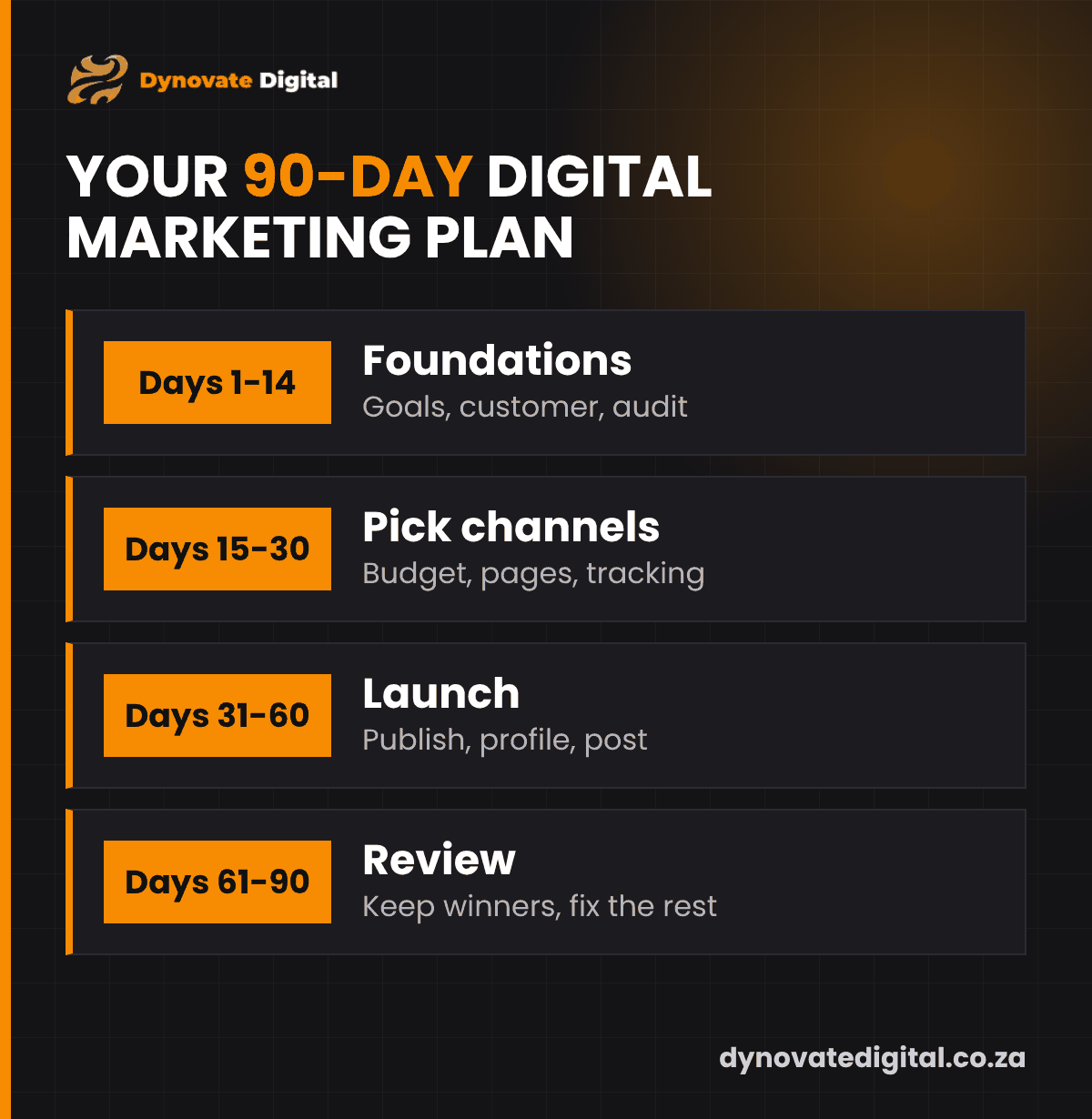
Days 1 to 14: Foundations
First, set your goals, define your customer and audit your website, Google profile and social profiles. Then fix wrong details and slow pages.
Days 15 to 30: Pick channels
Next, choose two or three channels, set your monthly budget and map each service to a page. Also, set up tracking in Google Analytics and Search Console.
Days 31 to 60: Launch
Then publish or improve your key pages, complete your Google Business Profile and start posting. If you need speed, start a small Google Ads test.
Days 61 to 90: Review and improve
Finally, look at what brought enquiries and what did not. Then double down on the winners, fix the weak pages and plan the next 90 days.
Eight digital marketing mistakes to avoid
The most common reasons small business marketing stalls.
No clear goal
Because marketing without a number to aim at cannot be judged, set one first.
Too many channels
Because spreading yourself thin means nothing works well, pick two or three.
A slow or weak website
Since every channel sends visitors there, fix it first.
Ignoring Google Business Profile
Because it is free and often the fastest local win, complete it early.
Posting without a plan
Because random posts rarely bring customers, plan content around your goals.
No tracking
If you cannot see enquiries, you cannot improve them. Therefore, set up tracking early.
Expecting instant results
Although ads are faster, you pay for every click, and most channels need months.
Copying competitors
Because what works for them may not suit your customers, use them as a guide, not a template.
The tools worth using
What to use, and when to get help.
Free tools to start with
Google Search Console shows how you appear in search. Next, Google Analytics shows how visitors behave. Also, Google Business Profile manages your Maps listing, while PageSpeed Insights tests your speed. Finally, Keyword Planner shows what people search for.
When to add paid tools
Once your basics work, a tool such as Semrush can help with keyword and competitor research. However, you do not need paid tools to start. In fact, a clear strategy matters more than the software.
When to get help
If you lack time or want to move faster, a digital marketing agency can run the plan for you. Also, look for clear reporting, honest timelines and no guaranteed rankings. For example, our digital marketing agency in Midrand team works with small businesses across Gauteng, and our Sandton and Fourways digital marketing page covers clients in those areas.
Book your free digital marketing consultation
Tell us about your business and goals. We’ll review your online presence and recommend what to do first.
Book your consultation todayDigital marketing strategy: your questions answered
Strategy basics
What is a digital marketing strategy?
A digital marketing strategy is a plan for how your business will win customers online. It sets your goals, your target customers, your channels, your message and the way you measure results.
What should a digital marketing strategy include?
In short, it should include clear goals, a description of your ideal customer, the channels you will use, your content and offers, a budget and timeline, and the numbers you will track each month.
How is a strategy different from a marketing plan?
The strategy is the thinking: goals, customers and channels. Meanwhile, the plan is the schedule that puts it into action, with tasks, owners, dates and costs. You need the strategy first, because it tells the plan what to include.
Getting started in South Africa
Where should a small business start with digital marketing?
First, build the basics: a fast, clear website, a complete Google Business Profile and one channel that suits your customers. After that, add SEO, ads or social media as your goals and budget allow.
How much should a small business spend on digital marketing?
However, it depends on your goals, your industry and how quickly you want results. Instead, start with an amount you can sustain for at least six months, then adjust once you see which channels bring enquiries.
How long does digital marketing take to work?
For example, paid ads can bring enquiries within days or weeks. However, SEO and social media usually need a few months to build momentum. Therefore, set a realistic timeline and review your results every month.
Getting help
Can I build my own digital marketing strategy?
Yes. In fact, many owners start this way, and the seven steps in this guide give you a framework. As your business grows and time gets short, a specialist team can save you effort and costly mistakes.
When should I hire a digital marketing agency?
Also, consider an agency when you lack the time or skills to run the plan, or when you want to move faster. Besides, look for clear reporting, honest timelines and no guaranteed rankings.
How do I book a consultation?
First, use the Book your consultation button, call 072 189 1196 or send us a WhatsApp message. Then we will review your online presence and recommend what to do first.
Ready to build your strategy?
Tell us about your business and we’ll reply with a clear recommendation.